

Understanding the Meltemi: When Sailing in Greece Becomes More Relaxed
-
The Meltemi shapes summer in Greece like hardly any other weather phenomenon. For many sailors, it is a reliable companion, while for inexperienced crews it can sometimes be a challenge. Understanding when and how the wind develops in the Aegean allows you to plan your route, daily passages, and anchorages much more comfortably.
Especially in the Cyclades, the Meltemi often determines whether a day of sailing will be sporty, pleasant, or better spent in the harbor. This does not mean that sailing in Greece during the summer is problematic. On the contrary: with good preparation, the right choice of yacht, and a realistic understanding of wind and sea conditions, the Greek islands can be explored safely and enjoyably.
What Is the Meltemi?
The Meltemi is a dry, usually strong northerly wind that blows across the Aegean during the summer. It is caused by pressure differences between the Balkan region and the eastern Mediterranean. Its typical direction is from north to northeast, although in some areas it can also come from the northwest.
In Greek, the wind is often referred to as the “Etesian.” For sailors, however, its name matters less than its behavior: the Meltemi often builds up during the course of the day, reaches its greatest strength in the afternoon, and decreases again in the evening. During stronger periods, it can blow for several consecutive days.
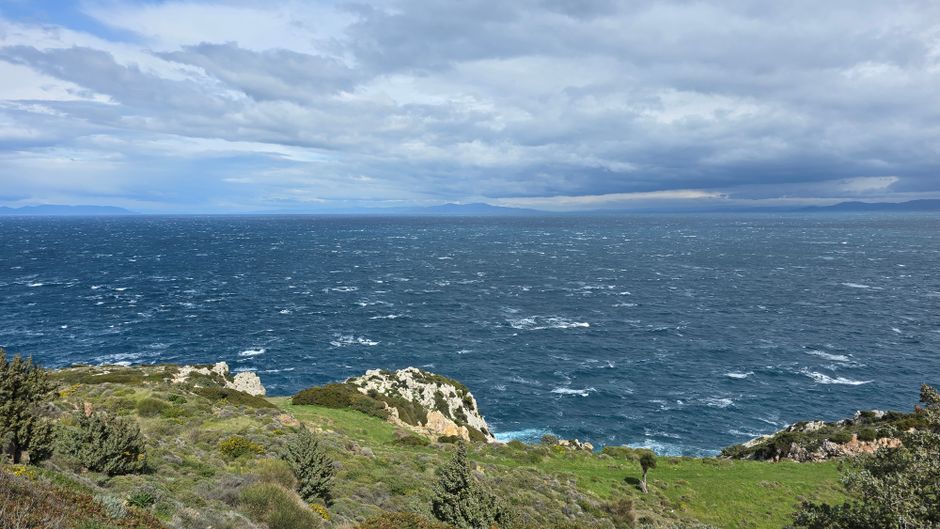
Depending on the region, the wind frequently reaches 4 to 6 Beaufort, and even stronger conditions can occur in exposed passages. Between the islands, funneling effects can develop, significantly increasing both wind and waves locally. This is precisely why it is important not to look only at the general forecast for Greece, but also at forecasts for specific sea areas, headlands, and channels between islands.
When Is the Meltemi Strongest?
The Meltemi season usually begins in late spring, becomes significantly more active during the summer, and reaches its peak in July and August. The Meltemi can still be noticeable in September, although it is often less consistent and somewhat more comfortable for crews who prefer more relaxed sailing.
The shoulder seasons are particularly interesting for more relaxed sailing. In May, June, September, and sometimes October, the weather is often stable, the sea is warmer than in spring, and harbors are less crowded than during the peak season. The wind remains a factor, but it often allows for greater flexibility when planning daily passages.
Within a single day, it is worth starting early. In many sailing areas, the wind is more moderate in the morning, the sea is calmer, and longer passages are easier to manage. Those who set off only in the afternoon will often be sailing precisely when the Meltemi reaches its strongest phase.
Where the Meltemi Has the Greatest Impact on Sailing
The Meltemi is most noticeable in the central and southern Aegean. The Cyclades, including islands such as Mykonos, Paros, Naxos, Ios, and Santorini, are considered a classic Meltemi sailing area. Here, long stretches of open water, accelerated wind fields between the islands, and short, steep waves can combine.
The Dodecanese islands farther south are also affected, although conditions vary from one area to another. In the Saronic Gulf around Athens, sailing is generally more sheltered, making the area particularly pleasant for beginners, families, and less experienced crews. Those who want to experience the Greek islands without expecting challenging wind conditions every day will find a good balance of culture, bays, and safe harbors there.
A bay on the lee side of an island may feel calm during a Meltemi, while challenging conditions can prevail just a few nautical miles farther offshore. For this reason, every passage should be planned not only according to distance, but also according to wind direction, shelter, alternative harbors, and the holding ground for anchoring.
Choosing the Right Route for More Relaxed Sailing
Relaxed sailing in Greece begins with choosing a route that matches the crew’s level of experience. Those sailing in the Aegean for the first time should avoid planning an overly ambitious island-hopping itinerary. Shorter passages provide greater peace of mind because, if the wind increases, there is still enough time to reach a sheltered harbor or suitable anchorage.
With a strong Meltemi, it is often easier to initially sail south with the wind. The return journey against the wind and waves, however, can become demanding. Experienced skippers therefore plan circular routes carefully and avoid situations in which the crew has to sail back to the departure port against strong winds on the final day.
Flexible daily destinations are helpful. A good route should include not only the desired islands, but also alternatives. If the wind is stronger than expected, stopping at a nearby island, heading for a sheltered harbor, or spending an additional day in port may be a much better decision.
Why the Boat, Crew, and Skipper Matter
Not every boat feels the same in Meltemi conditions. A modern sailing yacht with a well-maintained rig, a reliable reefing system, and appropriate safety equipment makes dealing with strong winds considerably easier. Catamarans offer plenty of space and comfort, but they respond differently to wind pressure and require particular attention in harbors and when anchoring.
The skipper’s experience is equally important. They need to be able to interpret weather forecasts, assess the crew’s capabilities, and make timely decisions. A sporty day of sailing can be exciting for experienced sailors, while the same conditions can quickly become exhausting for beginners.
The crew should also be prepared. This includes clearly defined duties on board, suitable clothing, sun protection, sufficient water, and realistic expectations. The Meltemi brings dry air and often excellent visibility, but its constant wind can be underestimated. Fatigue is caused not only by high waves, but also by noise, movement, and the need for continuous concentration.
Practical Tips for Safe Days at Sea
Those sailing in Meltemi conditions benefit from a few simple routines. Weather forecasts should be checked daily and, ideally, compared across several sources. Wind strength, gusts, wave height, and developments over the next 24 to 48 hours are particularly important.
It is also advisable to:
- Depart early, before the wind strengthens during the day
- Reef in good time rather than waiting until the sails are overloaded
- Choose sheltered anchorages on the lee side of islands
- Keep passages short when the forecast is uncertain
- Know your alternative harbors before setting off
The Meltemi also deserves attention in harbor. Crosswinds can make berthing maneuvers more difficult, especially in narrow harbor basins. Mooring lines, fenders, and clear communication on deck help reduce stress. In popular sailing areas, arriving early is also advantageous, as berths can become scarce quickly during the high season.
When Is Greece Particularly Pleasant for Sailing?
For crews looking for warm weather, Greek islands, and lively harbor towns while hoping to avoid extreme heat and strong winds, June and September are often ideal. The sea is inviting, many tavernas and marinas are open, and conditions are generally more balanced than during the height of summer.
Greece remains a fascinating sailing destination in July and August, but it requires more attention. Those choosing the Cyclades during this period should not regard the Meltemi as a disruption, but as an integral part of the region. With appropriate planning, the wind does not become a problem but rather an element that defines the character of the Aegean.
Agencies such as Scan2Sail can assist with choosing the sailing area, yacht size, travel period, and equipment, especially when comfort, flexibility, and personal preferences all need to be taken into account. The key is to choose a sailing area not only based on beautiful pictures, but also on wind conditions, experience, and the desired pace of travel. This way, the Meltemi becomes not a source of uncertainty, but a well-understood companion between islands, harbors, sea, and horizon.